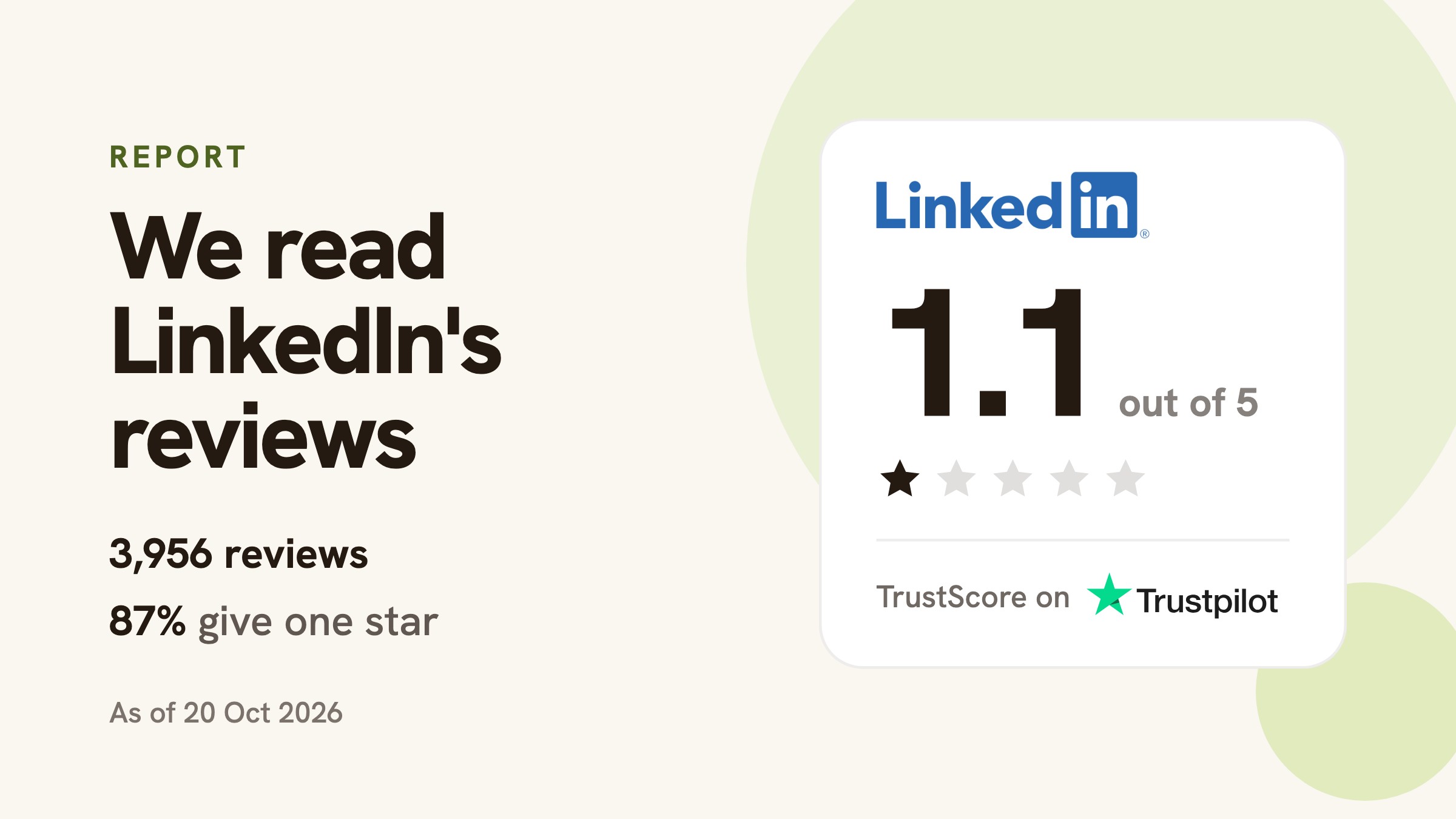
A 1.1 out of 5
On 20 October 2026, LinkedIn's page on Trustpilot showed a TrustScore of 1.1 out of 5, from 3,956 reviews. 87% of them give one star.
We make Guap, an app for finding and applying to jobs, so we went and read them. Not all of them: the newest, and the ones that talk about jobs, ghosting and Premium. Most of the ones we read are not about networking at all. They are about looking for work, and about the place built for it getting in the way.
Below is what people wrote, what the research says about why it hits people early in their careers hardest, and what Guap does about each complaint. Where LinkedIn is still worth your time, we say that too.
Why it lands hardest when you are starting out
LinkedIn works best for people who already have a network. Their posts get seen, their contacts make introductions, and recruiters come to them. If you are 22 and just finished studying, you get the other half: the ads, the job posts and the silence.
LinkedIn's own research says much the same:
- In a survey of 18,050 professionals in 12 countries (run by Censuswide for LinkedIn in July and August 2026), 72% of Gen Z (the study sampled at least 150 people aged 18 to 29 in each country) said they feel disconnected from people who could help their careers. 64% said no one has clearly shown them how to build professional relationships, 37% worry about being judged and 34% about sounding inauthentic.
- In LinkedIn's Job Search Safety Pulse (8,512 professionals in the UK, US, India, Germany and Brazil, March 2026), 32% of Gen Z said they had been the victim of a job scam, against 17% of Gen X. 32% of Gen Z also admitted ignoring warning signs, against 8% of Baby Boomers.
- Outside LinkedIn, PeopleScout's Inside the Candidate Experience 2026 (more than 1,000 job seekers) found that 76% of 18 to 24 year olds were ghosted on more than half of their applications, more than any other age group.
The first two are LinkedIn asking professionals in general; the third covers job seekers everywhere, not only on LinkedIn. Together they describe what the reviews do: when you have the least to go on, you get the least back.
Jobs that are not really there
The first complaint is the one you meet before any other: listings for roles nobody is hiring for. Some are left up after the job is filled. Some were never meant to be filled. Either way, you spend an evening on an application nobody reads.
What Guap does. The jobs Guap finds itself come straight from each company's own careers page or its public applicant tracking board, not from job aggregators. Guap checks them again every night and closes a role once the company's listing drops it, or once its page is gone on two checks in a row. For a listing anywhere else, here is how to spot a ghost job before you apply.
In reviewers' own words:
“Literally every 3rd job advert is non-existent on the company's website”
“The job board is a total disaster, it's flooded with "Easy Apply" ghost jobs that never get a response and promoted listings that aren't even relevant to my field.”
“Linkedin is guilty of FALSE ADVERTISEMENT - advertising hundreds of ghost jobs - jobs that DO NOT EXIST.”
Applying into silence
The second complaint is quieter, because it is about nothing happening. You apply and never hear back. Not a no. Nothing.
What Guap does. Guap cannot make a company reply, but it can show you which ones do not. Company and job pages on Guap show how many Guap users got no reply from that company in the past year, once at least three different people marked an application Ghosted after two months or more of silence. Your own applications are tracked in one place, and after 60 days with no reply Guap suggests marking one Ghosted, so it stops taking up room in your head. It will not let you do it sooner.
In reviewers' own words:
“Well I have been applying since June, and 0 interviews just rejections, if I even hear back.”
“When you apply for a job, there's no response, not even a banal "You're not right for us."”
Paying to be seen
Premium comes up again and again. Some people feel pushed to pay just to be noticed while they are out of work. Others say a trial turned into a charge they did not see coming.
What Guap does. There is no subscription for job seekers. You buy a prepaid credit pack once, nothing renews, and credit never expires. Unused credit is refundable within 14 days. Autofill, sending your application, tracking, the calendar and reminders are free. Each paid action has a fixed price, from 5 cents, shown before you choose it, and new accounts get some uses free. Every price is on the pricing page.
In reviewers' own words:
“Why are they trying to squeeze job seekers into paying for premium?”
“LinkedIn doesn't send reminders on renewal of monthly subscription after a trial ends.”
“They Also Have the Nerve to Charge You to Message People!”
Locked out of your own account
Many of the angriest reviews come from people who cannot get into their accounts: flagged as a bot, restricted without a reason, or hacked and then restricted. When your job search lives on one profile, losing the profile means losing the search.
What Guap does. You sign in with a one-time code we email you, or with Google. There is no password to create or remember.
In reviewers' own words:
Falsely flagged for automation while just looking for jobs like every other student
“LinkedIn flagged my account for "automation detection" despite having zero automation tools installed on my machine.”
“LinkedIn restricted my account almost immediately after creation and refused to explain why.”
“My account gets hacked, my new account gets restricted, and LinkedIn does absolutely NOTHING!”
Strangers in your inbox, and nobody to call
The last group is about people. Some reviewers are tired of messages from recruiters and sellers they never asked to hear from. More of them say that when something goes wrong, there is no human to talk to.
What Guap does. On Guap, only a verified employer can start a conversation, and only with someone who applied to one of its own roles. Recruiters and strangers cannot cold-message you. And when something is wrong, tap Guappy in the navbar to send us a bug, an idea or a question. It goes to our team inbox, and a person writes back by email.
In reviewers' own words:
“It’s nothing but Corporate nepo-babies talking about how great their jobs are and solicitors trying to take advantage of people desperately looking for work.”
“What makes it worse is that there is no way to reach a human.”
“Support is 0 and folks will try to upsell you whilst looking for a job - who does that.”
Where LinkedIn still earns its place
None of this means you should delete your profile. Contacts still matter: in LinkedIn's own research, US applicants with an inside connection at a company were nearly 7x more likely to be hired. A tidy profile also helps when a recruiter looks you up after you apply.
Our advice is simpler than a platform switch: keep LinkedIn for people, and do not let it be your whole job search. Apply where the job really lives, keep track of who replied, and do not pay just to be noticed.
How we read the reviews
Guap wrote this, and Guap makes a job search app, so read it with that in mind. On 20 October 2026 we read LinkedIn's Trustpilot page: the newest reviews, and what the page returns when you search it for "job", "ghost" and "premium". The 14 reviews quoted here are copied word for word from the reviews themselves, and each card links to its review. We cut full names to a first name and last initial and left everything else as written, typos included.
The score and the count change every day; the numbers here are the ones the page showed that day. Every survey figure links to the page it comes from. We have no connection to LinkedIn or Trustpilot, and neither has seen or approved this article.